
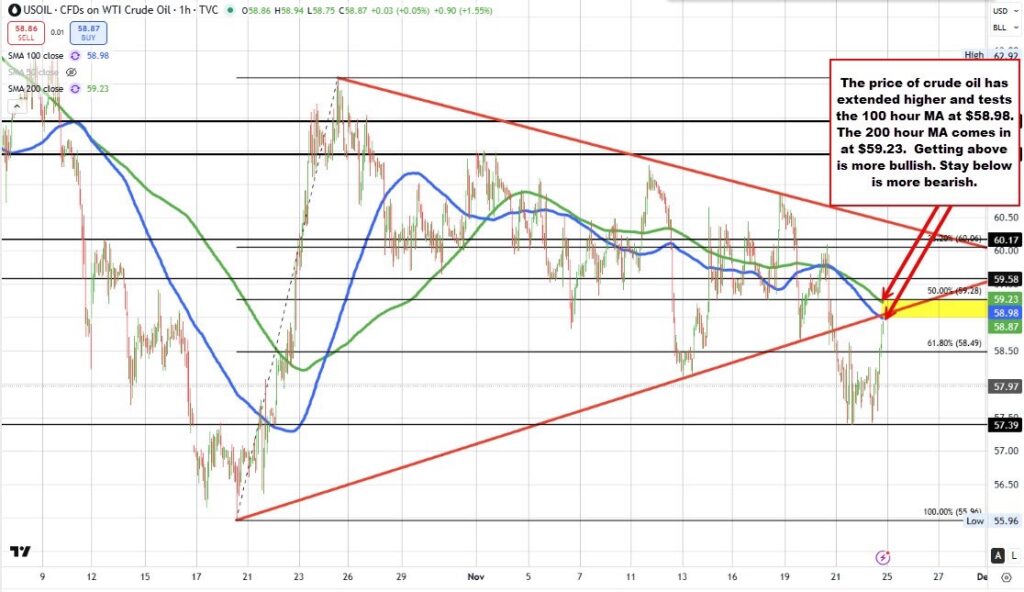
Crude oil futures settled near US $58.84 per barrel on the session, marking a modest rebound from intra-day lows. According to one source, U.S. crude rose to about US $58.84 in the latest inventory update.
Technically, price action is testing the vicinity of the 100-hour moving average (MA) on this rebound, which is acting as a key technical threshold in the near term.
Technical Landscape
The 100-hour MA is being used as a meaningful resistance level by short-term traders in the oil complex. In prior reports, price was seen “testing the falling 100-hour moving average” near ~US $60.79. With crude around US $58.84 and near a rebound, the fact that it is approaching this MA suggests that the market is at an inflection: either clearing above could trigger further upside momentum, while failure may lead to another leg lower. Moving averages are standard tools for traders of oil to smooth data and identify trend or counter-trend opportunities. On the broader technical front, as of recent data, the commodity remains under pressure from moving averages: one table shows the 100-day MA for WTI at about US $61.62 and the 200-day at about US $62.09 (daily timeframe) — although that is different from the shorter 100-hour MA.
Key technical levels to watch
Resistance: The 100-hour MA (approximate area) Support: Recent lows around the US $58–59 region If bulls can push through the MA, next targets might sit around prior swing highs (~US $60+). If the MA holds as resistance, watch for pullback toward the support zone.
Fundamental and Market Context
Supply concerns remain a wildcard: inventory data from the American Petroleum Institute (API) and upcoming Energy Information Administration (EIA) releases are being monitored closely. A bullish draw in fuel stocks could act as a catalyst. Demand remains somewhat mixed: global economic growth concerns, combined with energy-transition dynamics and regional weakening, continue to temper strength in the oil market. On the supply side, any push-pull from geopolitics, OPEC+ output policy or disruption risks could change the bias quickly — traders remain cautious.
Outlook for Traders / Brokers
Given your role as an introducing broker in forex and commodities, key messages to your clients might include:
The near-term trade is rangebound to cautiously bullish: the rebound tests resistance (100-hour MA) and a clean break higher could open momentum toward US $60+. Conversely, if price fails at the MA and rolls over, a breakdown toward US $58 or lower is plausible. Keep inventory data (API, EIA) front-of-mind. A surprise draw could weaken the MA resistance and trigger upside momentum. Risk management is critical: volatility remains elevated (oil often shows sharp moves on supply/demand surprises). From a hedging perspective (for producers/users), it may make sense to lock in positions if upside is uncertain rather than assume a runaway rally.
My Short-Term View
I lean slightly toward a moderate bullish bias if oil breaks above the 100-hour MA convincingly. Without that breakout, the bias remains neutral to slightly bearish, given the large structural headwinds (sluggish growth, alternative energy pressure). For now, the MA is the line in the sand.
