
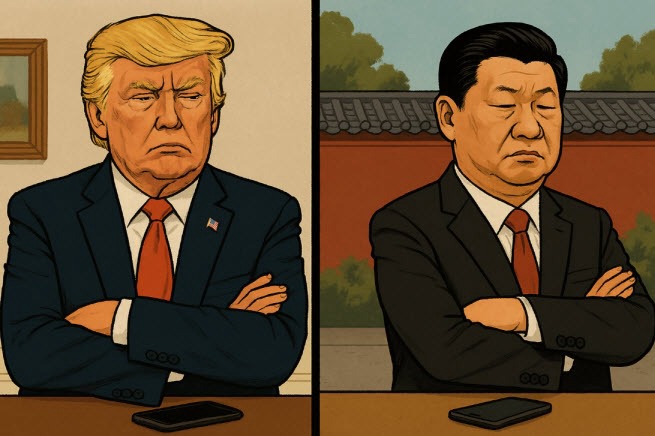
The United States and China have bought themselves more time, but not a lasting trade settlement.
Washington and Beijing have agreed to extend their existing trade truce by two months, pushing the arrangement that was due to expire on November 10 into January 2027. The extension came as Chinese President Xi Jinping met U.S. President Donald Trump in Washington, giving negotiators additional room to work toward a broader economic agreement.
The decision removes an immediate threat of another escalation in the world’s most important bilateral trade relationship. But beneath the diplomatic calm, several of the hardest issues remain unresolved — particularly tariffs, rare-earth supplies, technology restrictions and the broader question of how dependent the two economies should remain on each other.
A truce, not a trade deal
The latest agreement should be viewed as a pause rather than the conclusion of the trade dispute.
The existing framework has helped prevent another rapid increase in tariffs and retaliatory measures. Extending it to January 10 gives both sides additional time to negotiate without immediately facing a new deadline. U.S. Treasury Secretary Scott Bessent said the extension was intended to provide more time to determine what could be achieved on the economic front.
That distinction matters for businesses.
Companies can plan around a period of relative stability, but they still face uncertainty over the longer-term tariff structure. The United States and China continue to maintain significant trade restrictions, while negotiations over a potentially broader arrangement remain incomplete.
Rare earths remain Beijing’s strategic leverage
Perhaps the most complicated part of the negotiations is not conventional tariffs at all.
It is rare earths.
China has an exceptionally strong position across global rare-earth mining, processing and refining. These materials are essential to powerful magnets and are used across electric vehicles, electronics, renewable-energy equipment, aerospace and defence industries. Reuters has reported that China controls up to 70% of global rare-earth mining and more than 85% of refining and production.
That gives Beijing an important source of leverage.
China previously introduced tighter export controls on several rare-earth materials during the broader trade confrontation. Although some additional controls were suspended under earlier agreements, the issue has remained a major concern for Washington and global manufacturers.
For the United States, the objective is greater reliability and diversification of critical-mineral supplies.
For China, rare earths provide bargaining power in negotiations involving tariffs, technology and market access.
The result is an unusually delicate balance: tariffs can hurt Chinese exports and American consumers and businesses, while restrictions on rare-earth materials can disrupt manufacturing supply chains.
The tariff problem has not disappeared
The extension also leaves the tariff question hanging over global markets.
Neither Washington nor Beijing has completely dismantled the trade barriers accumulated during years of economic confrontation. Instead, the latest extension effectively keeps the existing framework alive while negotiators search for a broader arrangement.
That means companies importing goods from China into the United States, as well as American exporters selling into China, continue to operate under a complicated mixture of tariffs, exemptions and trade restrictions.
The May 2026 agreement already established mechanisms intended to manage bilateral trade, including proposed U.S.-China boards dealing with trade and investment. The White House also said China had committed to addressing supply-chain shortages involving rare earths and other critical minerals.
But implementation has been uneven.
Agriculture and aircraft add another layer
The negotiations extend well beyond tariffs and minerals.
China has committed to significant purchases of U.S. agricultural products, while earlier agreements included a commitment involving 200 Boeing aircraft. According to the Associated Press, progress on some of these commitments has been slower than originally anticipated.
This creates another potential bargaining mechanism.
Washington wants greater access for American farmers and manufacturers. Beijing wants stable access to the U.S. market while maintaining control over strategically important technologies and resources.
Both sides therefore have economic incentives to avoid a complete breakdown.
Why markets are watching closely
The temporary extension could reduce near-term fears of another tariff shock, but it does not eliminate uncertainty.
For investors, the biggest question is what happens when the new January deadline approaches.
A durable agreement could reduce uncertainty around global supply chains and international trade. Conversely, a breakdown in negotiations could revive concerns about tariffs, rare-earth shortages and renewed retaliation.
The implications extend into currencies, industrial commodities, technology stocks, manufacturing and potentially precious metals.
Gold, in particular, remains sensitive to geopolitical and economic uncertainty. A prolonged U.S.-China confrontation could reinforce demand for traditional safe-haven assets, while a meaningful reduction in tensions could shift some attention back toward risk assets.
The bigger issue: strategic dependence
The U.S.-China trade dispute has evolved beyond a simple argument about import duties.
It now involves technology, artificial intelligence, critical minerals, semiconductor supply chains, industrial policy and national security.
That makes a return to the pre-trade-war relationship increasingly difficult.
Even if Trump and Xi successfully extend their current truce again, businesses are likely to continue diversifying supply chains. The European Union, United States and other economies have increasingly focused on developing alternative sources of critical minerals and reducing dependence on concentrated supply chains.
In other words, the trade truce may calm the immediate dispute without reversing the longer-term restructuring of global commerce.
January becomes the next deadline
The extension buys Trump and Xi roughly two additional months.
That time could be used to negotiate a much wider agreement covering tariffs, agricultural purchases, rare earths, technology and investment.
But the core disagreements have not disappeared.
For now, the world’s two largest economies have chosen negotiation over escalation.
The next test will be whether those two additional months produce something more substantial than another extension.
The trade war may be on pause. The underlying economic competition is not.
